
News
» Go to news mainEngineering Change from Coffee to Coastlines

Two ambitious ventures. One already scaling internationally; the other still deep in prototype development. Both companies began when their student founders saw potential in undervalued resources, and both demonstrate how early-stage engineering support can drive high-value innovation.
At the Emera ideaHUB, RFINE and Equlantic have tapped into an ecosystem of mentors. Through programs like ideaBRIDGE and ideaBUILD, they have learned to apply rigorous design processes to transform early ideas into engineered prototypes and launch ventures with global potential.
RFINE Biomass Solutions Inc.: Turning Grounds into Good
For RFINE President and founder Quinn Cavanagh (MASc. 鈥�24), the entrepreneurial journey began during his undergraduate co-op work term. While working as an intern, he was tasked with emptying the wet grounds from the office coffee machine. 鈥淚 was struck by how much coffee we were throwing out as a small office of 15 people,鈥� Cavanagh recalls. 鈥淭his was perfectly usable biomass.鈥� According to RFINE鈥檚 market analysis, more than 60,000 tons of spent coffee grounds are generated worldwide each day.
That insight grew into RFINE, a cleantech venture upcycling spent grounds into KAFFIKA鈩� Cocoa Extender, a sustainable and delicious cocoa alternative.
Yet the path to entrepreneurship is never straight, as Cavanagh attests, 鈥淚 started with collecting spent coffee grounds to make brownies for Halifax coffee shops. But it wasn鈥檛 long before I realized the high costs and inefficiencies of having to drive all around the city to manually collect, dry, process, and deliver my product.鈥�
In search of a better way, Cavanagh shifted his focus to designing a drying system that reduces water weight and enables safe, cost-efficient collection of spent coffee grounds. His market research showed that coffee shops were spending $6,000鈥�$12,000 annually to dispose of wet coffee grounds. But to go from an idea to manufacturing a drying system required engineering expertise beyond Cavanagh鈥檚 chemical engineering background.
That鈥檚 where ideaBRIDGE became essential. Cavanagh credits his early residency days at the ideaHUB with providing the design support needed to build a compact unit that dries and stores grounds in food-grade containers for lightweight backhaul transport.
鈥淭he ideaHUB gave us a real design pathway,鈥� he says. 鈥淚 had the vision, but the HUB provided the tools, engineering expertise, and mentorship.鈥�
Fast forward two years and RFINE is part of CDL Atlantic. The company successfully operates both in-store and industrial drying divisions, diverting about 250 tons of spent coffee grounds each month for use in food ingredients and other applications. With cocoa prices at record highs, RFINE is positioning itself as a key player in sustainable food innovation, turning waste into a circular economy success story.
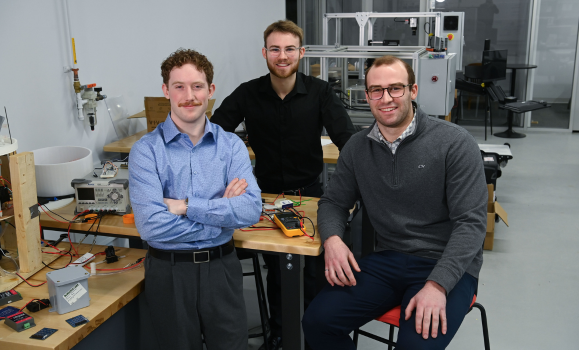
Equlantic Aquatic Monitoring Inc.: Turning Samples into Solutions
Equlantic, at the start of its entrepreneurial path, is developing the AutoSampler 鈥� a compact aquatic monitoring system. The idea originated when the student team won $10,000 at the Mission Innovation SMART CDR pitch competition in Norway, proposing a unique solution to meet water quality monitoring needs in the marine carbon dioxide removal (mCDR) industry.
According to Canada鈥檚 Ocean Supercluster, the fast-growing mCDR industry could help reduce the negative impact of ocean acidification and may become as聽big as Canada鈥檚 electric utility sector, attracting $30B in investment and creating 90,000 jobs by 2050.
With massive market potential, Equlantic鈥檚 competitive advantage comes from a multidisciplinary team. Its founders and engineers include Will Myrer (BEng 鈥�27), Isaac Bahler (BSc. 鈥�26), Rowan Norrad (BSc 鈥�26), Caliyena Brown (MSc. 鈥�28), Cameron Richardson (BSc.鈥�23), Dylan Moore (BEng 鈥�27), and Gregor Deveau (BEng 鈥�26) 鈥� who bring diverse academic backgrounds in earth sciences, environmental sustainability, marine biology, and mechanical, electrical, and computer engineering. This range of perspectives fuels creativity but also requires careful prioritization.
After more than 30 customer interviews, they found there was widespread frustration with existing monitoring systems. 鈥渕CDR companies run on data, but the tools haven鈥檛 kept pace,鈥� says Equlantic co-founder Will Myrer. 鈥淪ize, simplicity, and durability matter most.鈥�
Their first prototype, built quickly for Dal Innovates Demo Day, showed promise but needed a more rigorous engineering environment. Through the 10-month ideaBUILD program, they are refining mechanical, electrical, and software components. 鈥渋deaBUILD helps us break big problems into buildable steps,鈥� Myrer says. 鈥淭hat structured approach saves us months of going down the wrong technical paths,鈥� adds Dylan Moore, Equlantic鈥檚 embedded systems engineer.
With support from the ideaHUB鈥檚 lead engineer, Danielle Maltais, Equlantic has streamlined their system from 28 sample points to seven optimized ones. They are now testing underwater housings, integrating a printed circuit board system, and simplifying the user interface. 鈥淭he AutoSampler has to survive real world conditions,鈥� says Gregor Deveau, Equlantic鈥檚 electrical engineer. 鈥淭he ideaHUB鈥檚 prototyping support has been a game-changer.鈥�
With field testing ahead, Equlantic is preparing for pilots and partnerships within Nova Scotia鈥檚 fast growing mCDR sector.
Whether scaling globally or iterating prototypes two, three, or six times, founders connected to Emera ideaHUB gain the structure, discipline, and technical foundation needed to turn early ideas into high-potential solutions.聽
Recent News
- Meet the Team behind the Jumpsuits: How the 肉肉传媒 Engineering Gearheads are making an impact
- Celebrating 90 years of Dr. Dhandapani Thirumurthi
- From Wind to Sun to Steady Power
- Galaxia Mission Systems co鈥憃ps offer space tech experience
- Bringing the Future of Wireless Power to Halifax
- 17th Annual Engineering Golf Tournament
- Bringing Solar Power to a New Surface: A 肉肉传媒 Graduate Returns to Continue What He Started
- The beating heart of research: Capstone students鈥� research could help save lives of people with cardiac arrhythmia