

When it comes to renewable energy, rechargeable lithium-ion batteries have proven effective for applications such as electric vehicles. But concerns remain about the long-term viability of lithium as a resource, considering how much is needed to scale up.ĚýĚý
Drs. Jeff Dahn, Michael Metzger, Chongyin Yang and Lukas Swan, researchers at ČâČâ´«Ă˝, are working withĚý, CEO of Concordia’s , and private-sector partners to increase the use and efficiency of sodium-ion batteries.
Salt, being a much cheaper and more abundant material than lithium, has the potential to fuel a more sustainable alternative and complement to lithium-ion batteries.
“We’ve all been spoiled by oil,” says Dr. Dahn, professor of physics and atmospheric science at ČâČâ´«Ă˝ and the most senior Canadian researcher in the field. “The real application for sodium-ion is energy storage — stationary batteries that do not move, because sodium batteries are physically larger than lithium-ion.”
Advances in sodium-ion battery technology can support off-grid energy systems — in Quebec and Canada’s northern communities, for example — as well as zero-emission buildings. It will help decarbonize the built environment while reinforcing Canada’s global leadership in clean tech and battery systems.
The work builds on ČâČ⴫ý’s longstanding leadership in battery research.
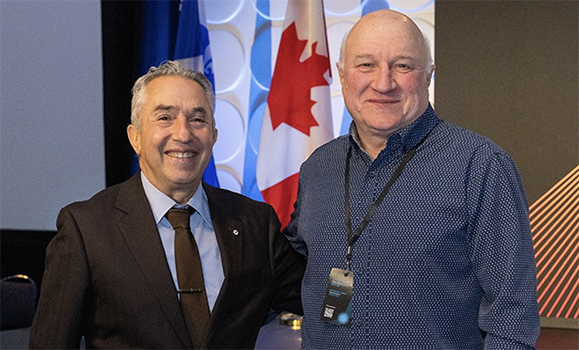
Dr. Karim Zaghib (left) and Dr. Jeff Dahn (right) at the Electrify Society Summit, held in Montreal on May 5-6.
The applications and advantages of sodium-ion
Dr. Dahn has been working on lithium-ion batteries since 1978. He started working with Tesla in 2016, and in 2021, his group expanded their research into sodium-ion batteries with the hiring of Dr. Metzger.
“The reason for working in sodium-ion is that people are concerned about the long-term sustainability of lithium at scale, because it’s far less abundant than sodium,” he explains. “Sodium-ion cells have come a long way. There are now sodium-ion cells that have an incredibly long lifetime, that can last many, many decades.”
People are concerned about the long-term sustainability of lithium at scale, because it’s far less abundant than sodium.
What began with two seed grants — one to develop sodium-ion chemistry suitable for residential energy storage, and one to help improve the energy density of sodium-ion batteries — is now an Impact Project aiming to develop residential scale energy storage systems using sodium-ion and other elements.
“We’re working on improving the lifetime of several different sodium-ion chemistries that could be selected for this,” says Dr. Dahn. “If you can park these batteries outside, at the moment it doesn’t matter how large they are.”
The advantages for our society are many.
“It’s believed they can be produced at lower cost and have longer lifetimes. If we think of it as a piece of public infrastructure, like solar farms, we should be asking, how long do we want them to last? That’s one of the things we’re working on. Things are progressing quickly — we’re excited.”
Supply chains and geopolitics
“We’re working with communities in the north of Quebec who are off-grid,” says , CEO of Concordia’s Volt-Age program. “Right now, many First Nations communities are still using diesel and gasoline for generators, which has become very expensive. Why not add batteries to store energy from solar and wind technologies? This is part of what Volt-Age is doing.”
The pivot to sodium-ion is logical giving not just the potential scarcity of lithium over time, but current geopolitics as well.
“Along with my colleagues at ČâČâ´«Ă˝ we want to help secure a green supply chain for Canada, compared to supply chains in other parts of the world,” he says.
There’s now a huge opportunity for Canada to play a leading role in the transition to clean energy.
Dr. Zaghib has been urging the Quebec government to quickly find better alternatives for energy storage.
“Because of the wars in Iran and Ukraine, for example, we need to pivot quickly to electrification. There’s now a huge opportunity for Canada to play a leading role in the transition to clean energy,” he says.